






What are the best charcoal puppy pee pads for odor control?
Key Takeaways
Charcoal pads can help with odor, but the right choice also depends on your dog, your floor, and how often you can change the pad.
- Match pad dimensions to your dog’s size and how they use the potty area.
- Check absorbency, backing, and odor-control details rather than relying on color alone.
- For overnight use or frequent accidents, prioritize capacity and a secure, leak-resistant setup.
- A smaller pad can work in a tight space, while travel pads should be easy to pack and place.
- Regular changes and a consistent potty routine still matter, even with charcoal.
1. Best overall charcoal puppy pee pads
The best charcoal puppy pee pads for odor control are the ones that suit your daily routine, not simply the ones with the darkest core or the biggest claims. Activated charcoal can help trap odors, but overall performance also depends on how quickly liquid is absorbed, whether the backing protects your floor, and how soon you replace a used pad. Think of odor control as one part of a practical setup.
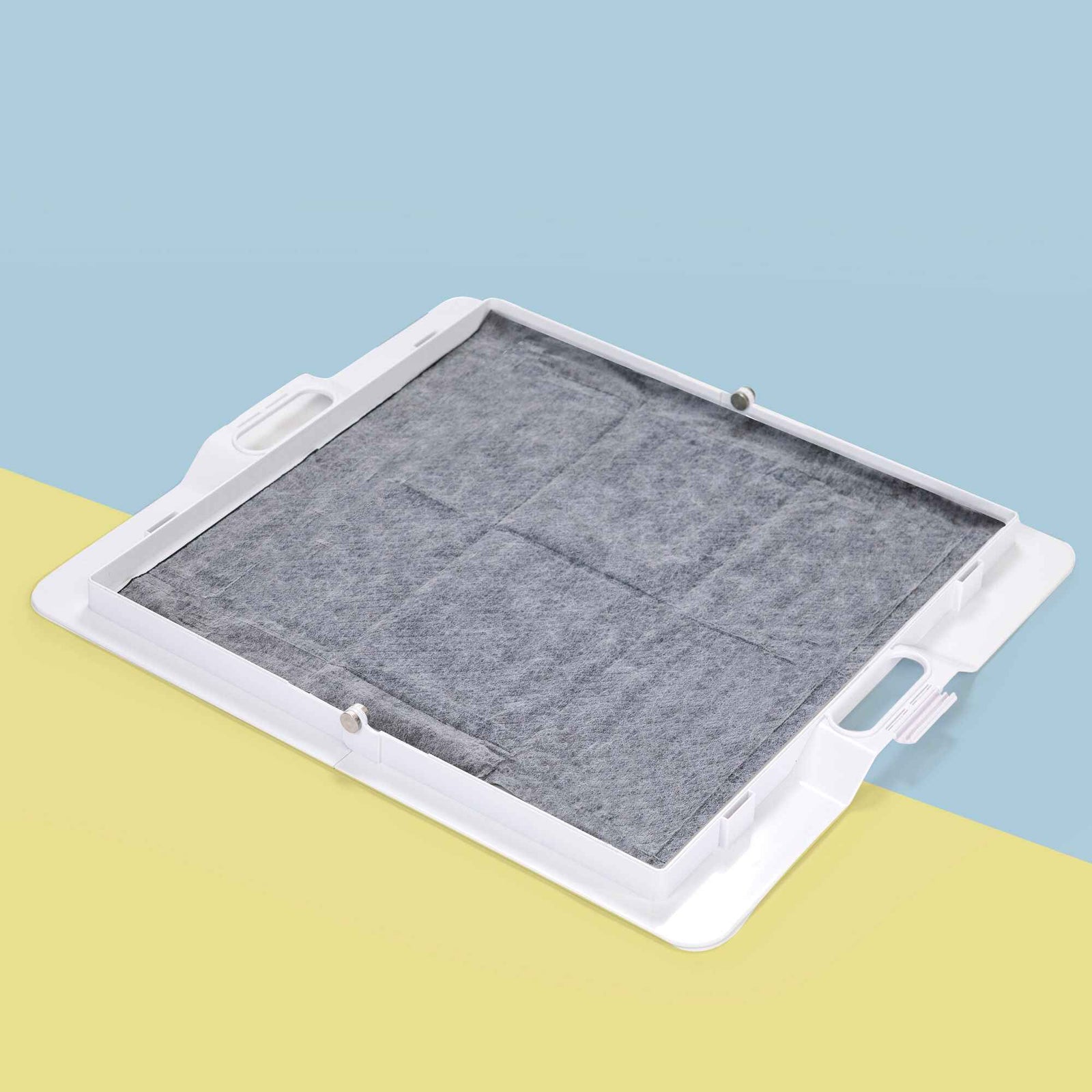
KindTail’s Odor-Filtering Charcoal Pee Pads are designed to fit the Pee PAWD® holder and offer odor control and absorbency. For any pad, check the listed dimensions and the intended holder or placement before buying. The whole setup matters: a pad that fits well and stays in place can make the potty area easier to manage.
A simple comparison can keep the decision grounded in your home’s needs. These are useful details to weigh side by side:
| What to check | Why it matters | A practical question |
|---|---|---|
| Pad dimensions | Determines how much of the potty area it covers | Does your dog fit comfortably on it? |
| Absorbency details | Helps you estimate how often you may need to change it | Is capacity stated clearly? |
| Backing or retention | Can help keep the pad from shifting or leaking | Will it stay put on your floor? |
| Odor-control materials | Clarifies what the pad uses to manage smells | Is charcoal specifically listed? |
Treat the table as a starting point, then consider your dog’s habits and your cleanup schedule. A well-matched pad can make an indoor potty spot simpler to maintain, but it is still worth checking it regularly and changing it promptly after use.
2. Best charcoal pads for large breeds
A larger dog needs enough room to step onto the pad, turn around, and use it without repeatedly missing the edges. Measure the potty area as well as your dog’s usual stance; a generously sized pad is only helpful if it fits the spot where you plan to use it. For big dogs, coverage can matter as much as the charcoal layer.
Some extra-large pads advertise broad coverage and high liquid capacity. For example, the XXL charcoal pads listing describes a 7-square-foot pad, absorption of up to 10 cups, and full-length sticky strips. Those are specifications for that particular listing, not a standard feature of every charcoal pad, so check the dimensions and claims on the product you are considering.
If your dog tends to stand near an edge or move around while using the potty area, choose a pad that gives them room without crowding a walkway. A holder with raised or enclosed sides may also help contain messes; the Pee PAWD® holder is described as having enclosed walls and a pad-retention system. Fit the pad and holder together before relying on the setup.
3. Best extra-large pads for overnight use
Overnight use calls for a little more breathing room: a pad should cover the likely potty area and have capacity suited to your dog’s needs. No disposable pad should be treated as a substitute for checking on a puppy or changing a saturated pad, but a larger format may help reduce the chance of a missed edge while everyone is asleep.
Look for clear dimensions and stated absorbency rather than assuming that “extra-large” means the same thing across products. If the pad will sit in a crate or a defined corner, measure that space first. A pad that bunches against the walls or folds underfoot can be less useful than a smaller one that lies flat.
Consider your puppy’s nighttime routine, too. If accidents happen at a predictable time, a final potty break and a morning check can help keep the area manageable. For a dog that uses pads overnight, choose a size with comfortable coverage, then replace it as soon as practical after waking.
4. Best leakproof pads for hardwood and tile
Hardwood and tile are easy to wipe, but liquid that escapes the pad can still spread into seams or along a baseboard. Start by checking for a waterproof or leak-resistant backing and make sure the pad lies flat on a clean, dry surface. On smooth flooring, stability deserves attention alongside absorbency.
A holder can add another layer of containment by keeping the pad in a defined area. The Pee PAWD® holder has enclosed walls and a secure pad-retention system for a 24-by-24-inch charcoal filter pad. Those details may be useful if your dog steps on the edge or nudges the pad while moving around.
Before settling on a permanent spot, watch how your dog approaches and leaves the potty area. If the pad slides or an edge curls, adjust the placement or use a holder suited to the pad’s dimensions. Wipe up any spill promptly, and check the floor beneath the pad from time to time rather than assuming the surface is protected.
5. Best heavy-duty pads for frequent accidents
When accidents are frequent, capacity and routine become especially important. A heavier-duty pad may be a sensible option if its stated absorbency matches your dog’s needs, but the label alone cannot tell you how long a used pad should remain down. Check the area often and change the pad when it is wet or soiled.
Compare the construction details that are actually listed: number of layers, backing, absorbency, and any charcoal or activated-carbon component. Avoid assuming that all charcoal pads share the same materials or performance. Clear specifications are more useful than a broad “heavy-duty” label when you are trying to choose a reliable everyday option.
If your dog repeatedly misses the pad, consider whether the potty area is large enough and easy to reach. Frequent cleanup may point to a fit or placement issue as much as a capacity issue. A stable, defined potty spot and a consistent schedule can help make the daily routine calmer for both you and your furry family member.
6. Best budget-friendly charcoal pads
A low price per pack does not always mean better value if the pad is too small, needs frequent replacement, or does not suit the place you plan to use it. Compare cost per pad alongside size and stated absorbency. Also consider how many you will go through in a typical week, since that gives you a more realistic sense of ongoing expense.
Product comparisons are most useful when they focus on what is included and what the terms say. That habit applies beyond pet supplies: readers may also compare coverage details for DA Direkt, explore Chris Gulli Consulting, or browse Bochord, La Pedrera, and Lactobacillus Plantarum. These are different subjects, of course, but checking the actual details rather than relying on a headline is a useful way to shop.
KindTail’s Potty Training Bundle includes a Pee PAWD holder and 100 odor-filtering charcoal pee pads. If you are considering a bundle, compare what it contains with the number and size of pads you would otherwise buy; a set only makes sense if its pieces suit your space and routine. For a broader look at the price question, this charcoal-pad cost comparison offers another perspective on weighing odor control against the extra cost.
7. Best fast-drying pads for busy households
A quick-drying surface can be helpful when several people share cleanup duties or a puppy uses the pad throughout the day. Look for a product that specifically describes its surface or drying behavior; “charcoal” by itself does not tell you how quickly the top layer dries. Also consider whether liquid spreads across the pad or stays within a smaller area.
Even with a pad designed to absorb quickly, prompt replacement remains a practical habit. Keep spare pads where you can reach them, and check the potty spot during the day rather than waiting until a smell becomes noticeable. A small routine can prevent cleanup from turning into a bigger chore.
If you have a busy household, pick a location that is easy to inspect and clean around. Make sure everyone knows where fresh pads are stored and where used ones go. Simple, repeatable steps often matter more than an elaborate setup.
8. Best pads for small puppies and tight spaces
A compact pad may fit a small puppy’s needs and leave more room in an apartment, laundry area, or play space. Measure the floor before buying, and leave enough space for your puppy to step fully onto the pad. A tight fit against furniture can make access awkward, especially for a puppy still learning where to go.
Small pads can be convenient, but they may need changing more often if your puppy uses them frequently. Consider whether the pad’s dimensions allow for a little movement rather than expecting precise aim from a young dog. If misses are common, a larger pad may save time and floor cleanup even when space is limited.
Keep the potty location consistent while your puppy learns the routine. A clear, easy-to-reach spot helps make the destination obvious, and a pad that stays flat is easier to use than one that shifts around. Reassess the size as your puppy grows or its habits change.
9. Best charcoal pads for travel
For travel, a pad should be easy to pack and appropriate for the place you are going to use it. Think about the available floor space, how long you will be away, and whether you can bring a few spares. A familiar potty routine can make a new setting feel less confusing for your dog.
Before heading out, it helps to make a small checklist so the potty stop is easy to set up and tidy away:
- Pack enough pads for the trip, plus a few extras.
- Bring disposal bags and a small supply of wipes.
- Choose a flat, low-traffic spot for the potty area.
- Check that the pad stays in place on the surface.
These basics keep the setup flexible without taking over your bag. If you travel with a holder, confirm that it fits the pad and can be carried comfortably; otherwise, a pad that lies flat in the chosen spot may be simpler. After use, seal the soiled pad for disposal and clean any area around it.
10. Best eco-conscious charcoal puppy pads
Disposable charcoal pads are convenient, but they create waste with each change. If reducing disposables is a priority, compare reusable options and check their care instructions, materials, and dimensions. A washable pad is a different kind of product, so make sure it suits your dog’s routine and that you can wash it as directed.
A reusable option can also work as a crate liner or travel mat if its size and construction fit the intended use. For example, the site’s Lovewag Washable Dog Pee Pads are described as reusable, machine washable, and fitted with a leak-proof layer and non-slip backing. Those are product-specific details; check the care guidance and size before choosing one for your home.
There is no single best choice for every family. Some pet parents may prefer the convenience of disposable charcoal pads, while others may want a washable alternative for everyday use. Choose what you can maintain consistently, and keep your dog’s comfort and the cleanliness of the potty area in view.
Conclusion
The right charcoal puppy pad balances odor control with practical details: size, absorbency, backing, placement, and how often you can change it. Start with your dog’s habits and the space you have, then choose a setup that feels manageable in your real daily routine. A little planning can make indoor potty time easier for your puppy and the whole household.
Frequently Asked Questions
Do charcoal puppy pads help control odor?
Activated charcoal can help trap odors, but results depend on the pad’s construction and how promptly it is changed. Regularly checking the potty area still matters.
How often should I change a puppy pee pad?
Change a pad when it is wet or soiled, and check it frequently during the day. Your puppy’s age, habits, and the pad’s capacity all affect how often it needs replacing.
What size pee pad should I choose?
Choose a pad that gives your dog room to step on, turn around, and use it comfortably. Measure the available space and consider whether your dog tends to move around while going.
Are charcoal pads suitable for large dogs?
They can be, provided the pad is large enough for the dog and has suitable stated absorbency. Check dimensions rather than relying only on the “large” or “extra-large” label.
Can I use puppy pads on hardwood floors?
Yes, but check for a leak-resistant backing and make sure the pad lies flat. Inspect beneath it periodically and clean up any spill promptly.
Are washable pee pads more eco-conscious?
Reusable pads can reduce reliance on disposable pads, but their overall fit depends on care, washing, materials, and how often they are used. Follow the product’s washing instructions.
Do puppy pads replace outdoor potty training?
Not necessarily. Pads can provide an indoor potty option, but whether they are part of a longer-term routine depends on your household and training goals. Consistency helps either way.
Leave a comment
Comments will be approved before showing up.